


Arne Saatkamp and his team have published new research in Global Ecology and Biogeography, which uncovers significant changes in Mediterranean vegetation due to climate change. Their paper delves into how climate change dramatically alters plant species and ecosystems, particularly in low-altitude regions. Their work is the result of studying plants of Southern France in a period spanning from 1980 to 2020.
The team examined records from the SIMETHIS database, which covers vascular plants from southeast France. Their findings indicate an increase in the temperature requirements of plant communities, with more significant change experienced at lower altitudes. This shift aligns with observed climate change data, suggesting that these changes are causing a gradual upwards shift in vegetation, especially among dry-adapted species at low altitudes. This effect is termed “thermophilization”, referring to the process where ecosystems adapt to warmer temperatures. At the same time, there’s an increase in moisture requirement at high altitudes.
Moreover, the team observed a transition in vegetation to warm-preferring species in the lowlands. This effect was stronger in the lowlands than in the uplands, indicating a faster response of vegetation to warming at lower altitudes. This phenomenon is more pronounced in open habitats due to higher species turnover, particularly in areas with frequent disturbances that maintain diversity.
Another significant finding is an increase in plants with drier realized niches in lowlands, a process known as “xerophytization”. In contrast to thermophilization, the shift towards xerophytization fades away at mid-altitudes and primarily affects the lowland region.
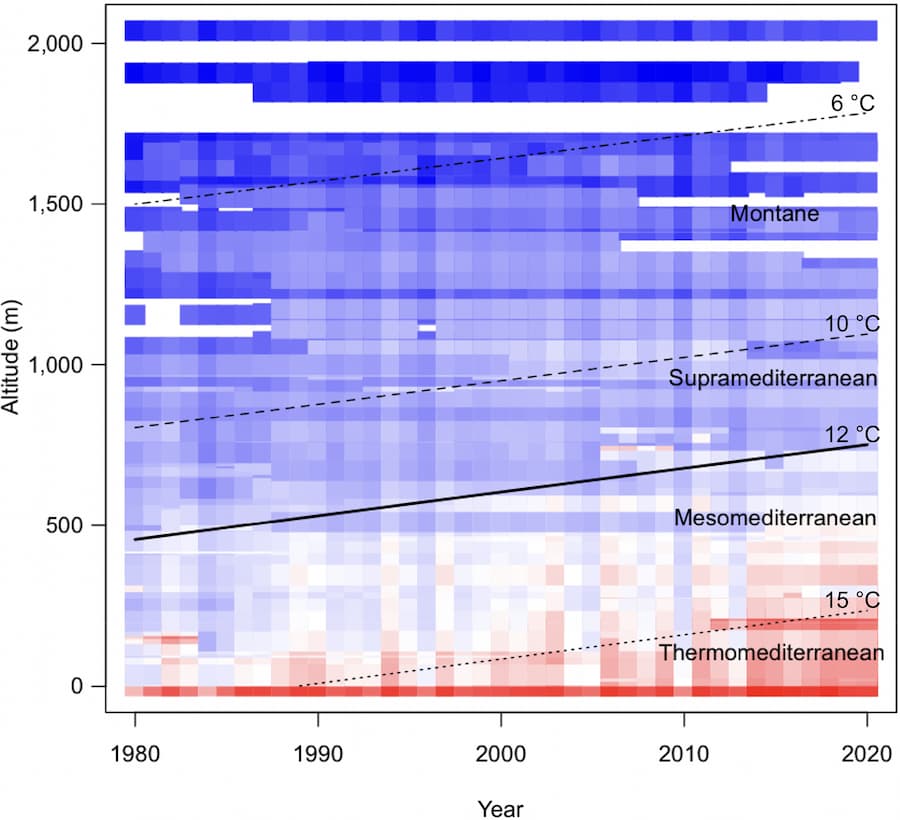
Data from the study shows a warming of 1.8°C from 1980 to 2020 in southern France. This finding aligns with other studies in the Mediterranean basin and Europe. Climate observations also indicate an increase in rainfall during the same period. This change, coupled with the rising temperature, impacts evapotranspiration – the process through which water is transferred from the land to the atmosphere – thereby altering the climatic water balance. These shifts suggest that the floristic altitudinal gradient increased, contributing to more substantial vegetation changes at low altitudes.
In their article, Saatkamp and colleagues write:
Our analysis made it possible to quantify the large impacts of recent climate change on a regional flora with strong climatic and floristic gradients. The increases in rainfall, PET [potential evapotranspiration] and drought at low altitude as indicated by water balance data, suggest that climatic water balance is particularly useful to understand vegetation changes as it is the only factor that retraces the stronger vegetation changes towards drought-adapted plants at low altitudes and stability or increase of moisture demanding plants at high altitudes. Our study underlines that reactions to temperature and moisture changes are complex and the need for detailed information on interactions between temperature, rainfall, soil and relief features in order to better understand water resources available to plants, and hence climate change impacts on vegetation.
Saatkamp et al. 2023.
The data gathered by Saatkamp and his team imply that the altitudinal limit of the Mediterranean zone in southern France moved upwards during the study period. This development impacts both cultivated and wild plants. Furthermore, the research indicates that vegetation lags behind climate at high altitudes for temperature requirements, which is particularly notable for lowland areas. It highlights the pressing need for further research to understand the interactions between temperature, rainfall, soil, and relief features, which are essential to predicting climate change impacts on vegetation.
READ THE ARTICLE
Saatkamp, A., Argagnon, O., Noble, V., Finocchiaro, M. and Meineri, E. (2023) “Climate change impacts on Mediterranean vegetation are amplified at low altitudes,” Global Ecology and Biogeography, 32(7), pp. 1113–1126. Available at: https://doi.org/10.1111/geb.13682.


