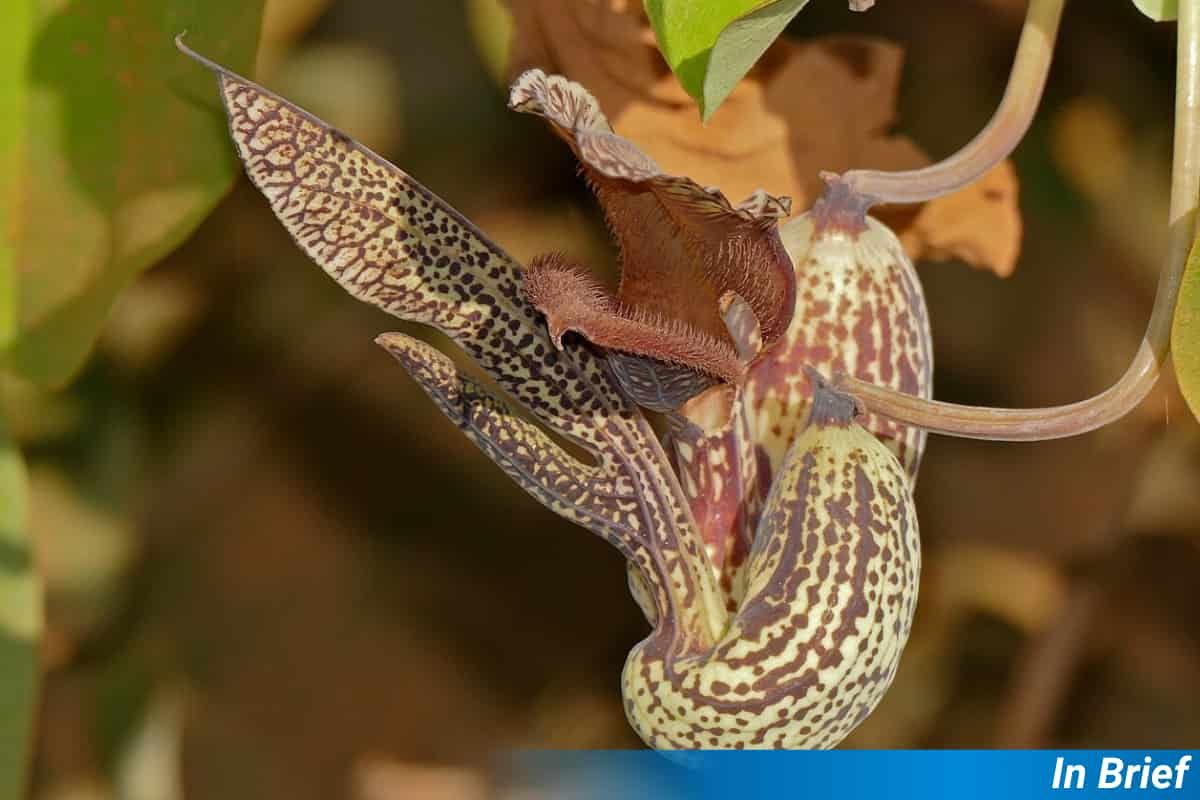

Matallana-Puerto and collaborators studied the trap flowers of Aristolochia esperanzae, a South American vine from the subtropical region of South America pollinated by flies. They discovered that tiny hair-like structures called “trapping trichomes” are essential for pollination success. Therefore, the research provides exciting insights into the reproductive biology of plants where such structures are present.
To investigate this, the team conducted a thorough study of the species’ floral biology. Then, they conducted an experiment with intact flowers and flowers where trichomes were manually removed. They observed pollinator behaviour, counted trapped insects, measured pollen removal and fruit production, and examined the trichomes’ structure using various microscopy techniques.
The researchers found that flowers with intact trapping trichomes captured 125 times more insects than those without. These trichomes increased the slipping of fly pollinators and, as a result, kept pollinators trapped until pollen was ready, ensuring successful pollination. In fact, Such is the importance of trapping trichomes for this process that flowers without trichomes didn’t produce any fruits.
While previous studies had suggested trichomes might be important for pollination in trap flowers, Matallana-Puerto’s study is the first to experimentally prove their role. The evidence provided by this research paves the way for exciting research on this fascinating plant group and its mesmerizing pollination biology.
Matallana-Puerto, C.A., Brito, V.L.G., Kuster, V.C., Oliveira, P.E. and Cardoso, J.C.F., 2024. Sex, flies and flower trap: Trapping trichomes and their function in pollination. Functional Ecology. https://doi.org/10.1111/1365-2435.14633 (OA)
Cross-posted to Bluesky, Mastodon & Threads.
Cover image by Bernard DUPONT from FRANCE – Pipe Vine (Aristolochia esperanzae), CC BY-SA 2.0, https://commons.wikimedia.org/w/index.php?curid=51220889