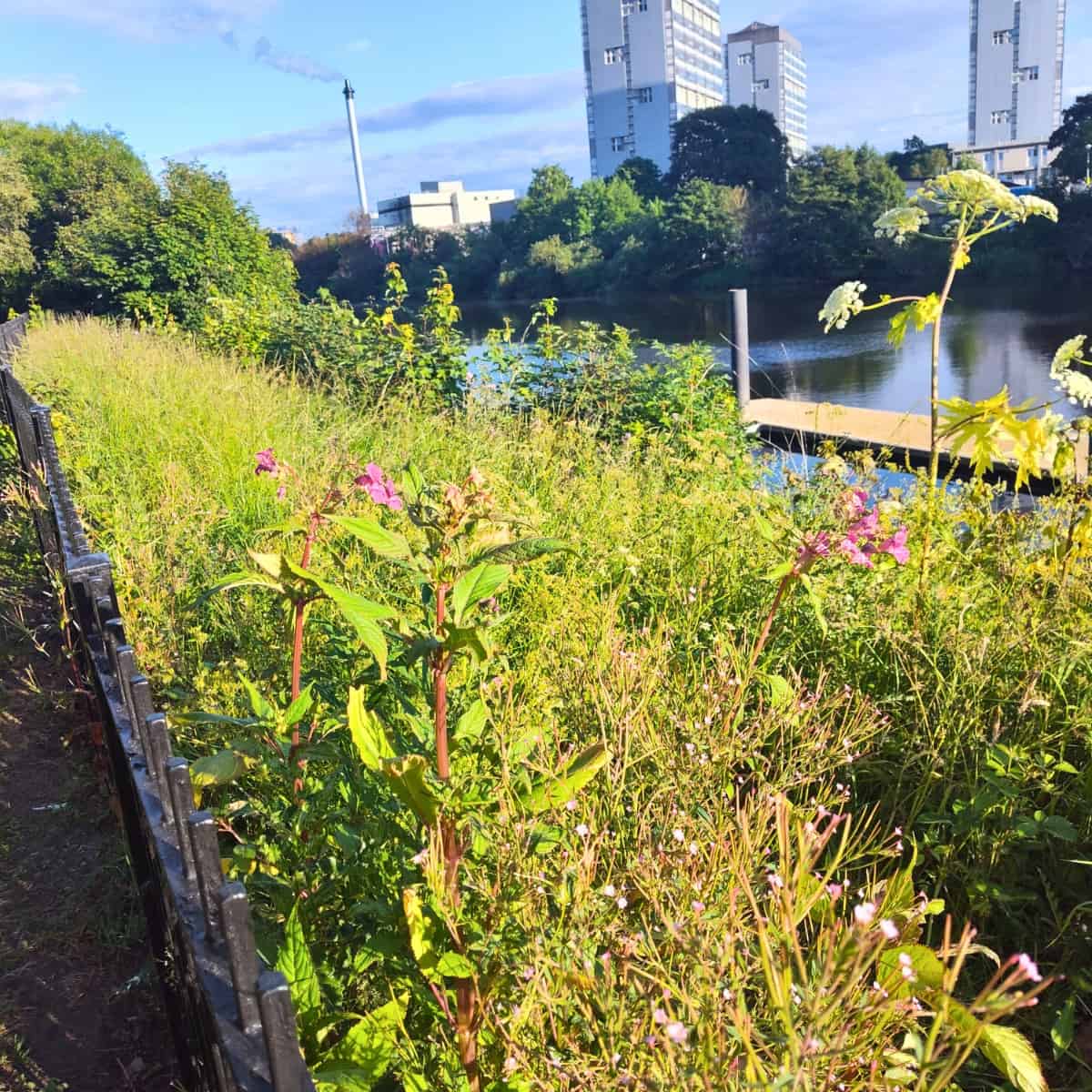



One of the problems of admiring exotic plants is actually getting to see them. They’re usually a long way off. Wouldn’t it make sense to bring them from their home range and grow them here? In the 1830s some people thought that Himalayan Balsam was exactly the sort of thing that make a riverbank look pretty. But while Himalayan Balsam is spreading as an invasive species through Europe, some riverbanks are disappearing and research published in Biological Invasions shows the two are connected.
Himalayan Balsam, pretty and relentless
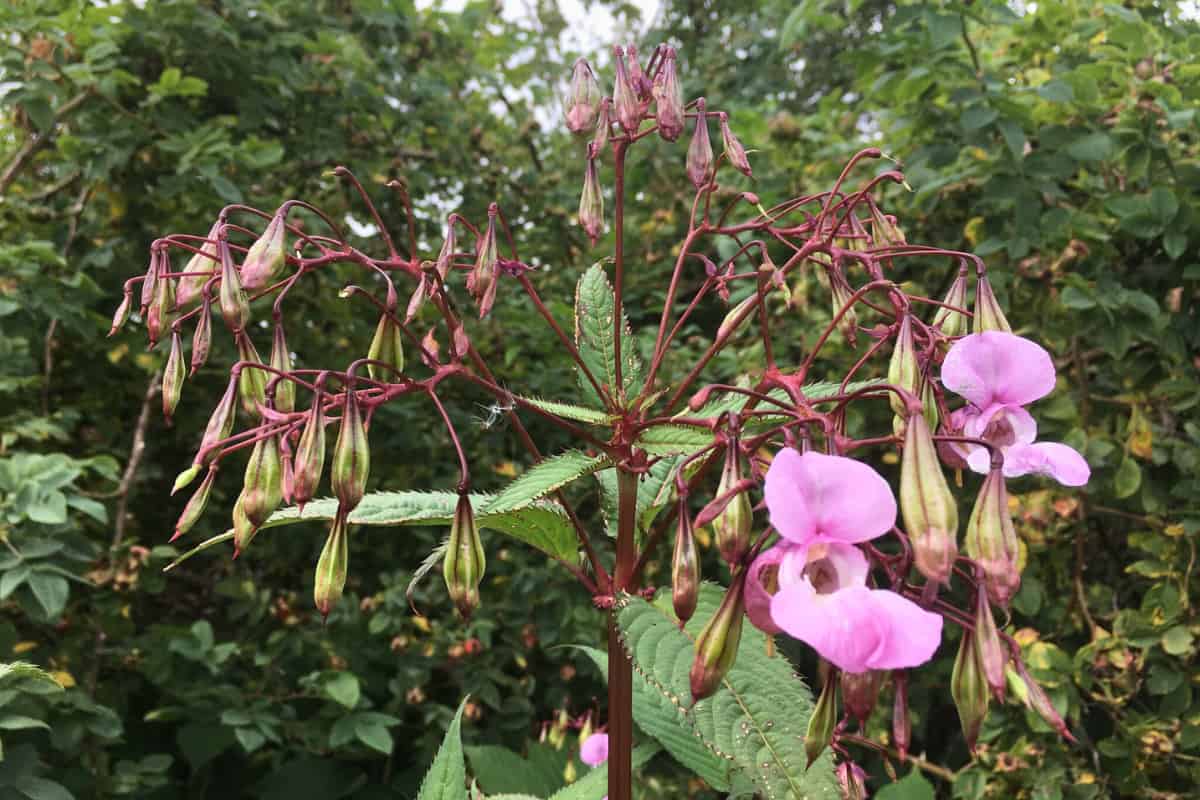
Himalayan Balsam, Impatiens glandulifera, is an annual plant that comes, as its name suggests from the Himalayas. In one year it grows from seed, rockets up to a height of two metres, produces pink blooms that draw in pollinators, casts its seeds, and dies back. In summer it can cover a riverbank, crowding out other plants, and that’s a problem in winter.
In winter it dies back to nothing. This leaves bare ground where normally there’d be at least some native grasses or nettles biding their time over winter. And that’s a problem in the UK, because winter is when rivers run fastest. By outcompeting native plants and then dying back completely each year, Dr James Hardwick and colleagues wondered if Himalayan balsam makes invaded riverbanks more susceptible to erosion during high-flow periods.
How do plants outside the river, help shape it?
Water is always flowing in a river, and always eroding the river bank, but plants can help provide natural defences against the worst of the flow. When floods come, the stems above ground slow the water’s flow, reducing the force against the river bank. In the soil the roots form a mesh, helping bind the soil together. Native plants do this year-round, because they’re perennials.
Himalayan Balsam breaks this pattern. As an annual plant it starts from seed in spring and dies completely in autumn. By the time winter comes, there is nothing left. Scientists thought this might weaken riverbanks, but this hadn’t been measured properly.
The problem then is a potential double-hit to riverside ecosystems. First Himalayan Balsam drives out other plants from a habitat. Then it leaves riverbanks exposed, increasing the amount of fine sediment entering the water, damaging wildlife.
How do you measure the damage?
The researchers chose eight stretches of riverbank along two rivers, the Tees in northern England and the Forth in Scotland. For each invaded stretch dominated by Himalayan Balsam, they found a nearby uninvaded stretch that matched it in every other way: similar river bend shape, similar slope, similar tree cover. This pairing was crucial as it meant any differences they measured couldn’t be blamed on the rivers just being naturally different.
They then measured the soil strength similar to how you would test soil firmness in agriculture. Using a penetrometer they could push into the soil to see how much force was needed to make it give way. They also used a torvane, a device to measure shear strength, to see how how the pushing of the river past the bank could tear away soil. They did this at 160 spots across all the sites, taking measurements both in summer when plants were growing and in winter after die-back.
Just as important as soil strength, they asked: what exactly was growing on each bank? The team identified every plant species, counted how much ground they covered, and measured how much bare ground appeared in winter. This seasonal tracking was critical. They needed to know whether summer Himalayan Balsam dominance really did suppress winter native vegetation, as suspected.
Balsam does its greatest damage when it’s not there
The figures are emphatic. Invaded banks lose about a third of their shear strength in the winter compared to the uninvaded banks. While all riverbanks lose some strength in winter, the invaded banks were losing a lot more. But it was the vegetation survey that revealed how the banks lost strength.
The survey revealed a cascade. Summer Himalayan Balsam didn’t just disappear in winter, its summer dominance actually reduced native plant diversity by about 25%. That meant that when the balsam died back, native perennial plants weren’t there to take over. That left bare ground and, with that no stems, roots or natural scaffolding to help support the soil.
Even in the long-term the team found that Himalayan Balsam caused problems. Some of the sites had been taken by Himalayan Balsam ten or fifteen years ago. Even after all this time, the native plants had not found a way to adapt. The Balsam was keeping the winter riverbanks bare and vulnerable. Once a riverbank was captured by summer balsam, it was condemned to winter hazard.
River defences need restoration as well as balsam removal
The headline finding “Invasive plant damages ecosystem” is not surprising, but the value of the research isn’t in finding what happens, but rather how and why. Lead author James Hardwick said in a press release: “Our work provides the first evidence that the impact of Himalayan balsam on the riverbank is not just about dieback. It’s about the way it suppresses native vegetation during summer, creating a loop that weakens riverbanks in winter. This seasonal mechanism has important implications for both river restoration and the management of invasive species.”
Clearly removing the balsam is important, and summer volunteers do important work, but their work alone will not be enough without extra support. The damage to native plant communities means banks may stay bare and vulnerable for several seasons. River managers may need to actively replant native species or protect banks during the transition, especially before winter high flows. The removal is still worth doing, but it’s a long term project.
The study shows how it’s not just the presence of invasive plants that’s the problem, it’s also the life-cycle. Hardwick and colleagues show that annual invaders in seasonal climates can be just as damaging as perennial plants, precisely because their life cycles mismatch with the environment’s vulnerability. As climate change and global trade accelerate plant invasions worldwide, understanding these timing mismatches becomes critical for predicting which newcomers will cause the most disruption.
READ THE ARTICLE
Hardwick, J., Hackney, C., Law, A. and Pattison, Z. (2026) “Invasive non-native plants indirectly destabilise riverbanks,” Biological Invasions, 28(1). Available at: https://doi.org/10.1007/s10530-025-03721-2
Cover image: Impatiens glandulifera on the banks of the river Clyde in Glasgow by Michael Koksharov/iNaturalist CC-BY-NC
ALT: Himalayan Balsam with characteristic pink flowers dominates the vegetated riverbank of the Clyde in Glasgow, with tower blocks visible across the water.


