

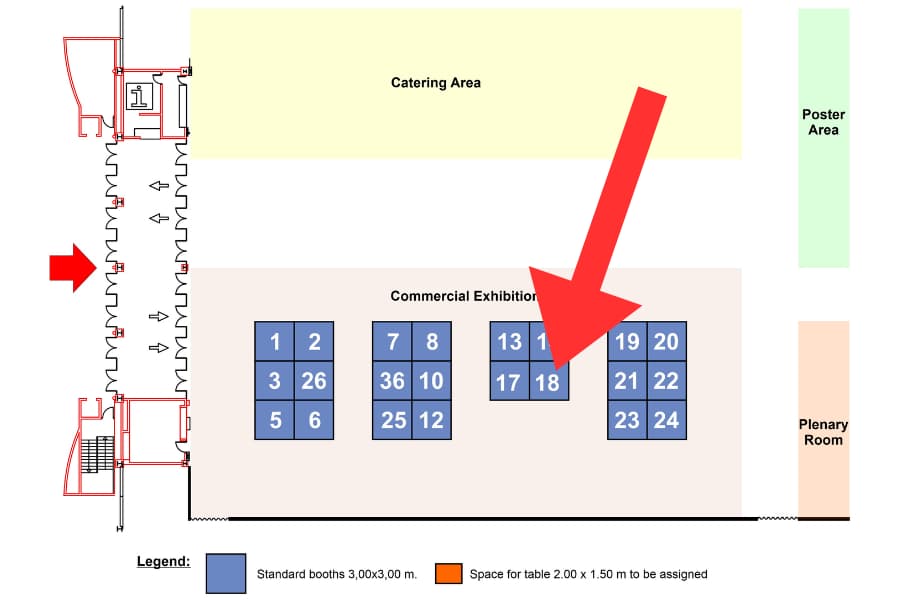
The Annals of Botany family is going to Madrid for the 20th International Botanical Congress. You can visit us at Stand 18 and around the site.
Our editors at IBC are:
Annals of Botany
Rowan Sage
Renata Cantoro
Gabriela Auge
Gitte Petersen
Lauren Baker
Olwen Grace
Martin Lysak
Muthama Muasya
Silvia Pressel
Adam Roddy
Trude Schwarzacher
Rachel Spigler
Kira Tiedge
Casper van der Kooi
Michele Dudash
AoB PLANTS
Xavier Pico
Renata Cantoro
in silico Plants
Rachel Shekar
Botany One
Carlos Ordóñez-Parra
Michela Osnato
Events to catch
Thursday, July 25
11am – 1pm: Endogenous pararetroviruses (EPRVs): their evolution, diversity, and regulation
Schwarzacher, Trude. University of Leicester, Department of Genetics and Genome Biology, Institute for Environmental Futures
2.35pm – 4.35pm: Poales: From Addressing Global Scale Questions to Unraveling the Evolutionary Secrets of Neglected Families
A session chaired by AoB editor, Muasya Muthama and Tammy Elliott.
- Cyperus margaritaceus and its relatives: How many species are there?
- Unprecedented variation pattern of plastid genomes and the potential role in adaptive evolution in Poales
- Global dominance in open and closed habitats is driven by unique traits in the Poales
- Evolution of holocentricity in cyperids
- Homology-based approach in assessing morphological diversity of Restionaceae
Location: A10.13
2.35pm – 4.35pm: 613/1683 Convergent evolution of floral visual signals via different optical mechanisms
Van der Kooi, Casper, University of Groningen.
Location: N105+6.
Friday, July 26
11am – 1pm: Evolution and Diversity of Carbon Concentrating Mechanisms (CCM) in Land Plants. Session 1
A sponsored symposium organsised by Gudrun Kadereit and AoB Chief Editor Rowan Sage
- C2 photosynthesis across scales
- Evolution of facultative and constitutive gene regulation in plants with CAM photosynthesis
- Comparative analysis of distribution and climatic preferences of C4 lineages
- CAM evolution is associated with gene family expansion in an explosive bromeliad radiation
- Diversity and evolution of CAM and CAM-related traits in the most species-rich Macaronesian plant radiation
- Leveraging facultative CAM for engineering synthetic CAM into C3 photosynthesis plants
Location: A10.1.
11am – 1pm: Fine-tuning plants to the environment – a role for genome size
Roddy, Adam, Florida International University
Location N103.
2.35pm – 4.35pm: Evolution and Diversity of Carbon Concentrating Mechanisms (CCM) in Land Plants. Session 2
A sponsored symposium organsised by Gudrun Kadereit and AoB Chief Editor Rowan Sage
- Defining the C2 photosynthesis phenotype across diverse plant lineages
- Soil organic carbon in tropical Andean ecosystems study methods and approaches: a systematic review
- Pyrenoid formation and carbon concentrating mechanisms in hornworts: contrasting dynamics but parallel molecular underpinnings
- Tree demography driving species composition and carbon stock changes in European forests
Location: A10.1.
2.35pm – 4.35pm: Fossil floras show early diversification in the evolution of Neotropical Rainforests
Carvalho, Monica, University of Michigan
Location: N101+2.
5pm – 7pm: Back to Basics: Using Micro-morphology, Anatomy and Histology to Investigate Evolution in Bryophytes
Symposium organised by Mathilde Ruche, Michelle Price and AoB Editor, Silvia Pressel
- The contributions of electron microscopy to bryology
- Peristome evolution in the Dicranidae revealed by SEM and histology
- Evolution and development of water-related traits in the dryland moss Syntrichia caninervis (Mitt.)
- Complex thalloid going simple: the importance of microanatomic traits in unveiling Dumortiera hirsuta’s diversity
- Fungal symbioses in bryophytes: anatomical insights on the evolution of mycorrhizal associations in land plants
- Refining our understanding of hygroscopic movements in moss peristomes using histology
Location: Colón.
5pm – 7pm: Color & chemistry: how flowers signal reward quality to pollinators
Tiedge, Kira¹
(1) University of Groningen
Location: N111+12.
Saturday, July 27
8.30am – 9.25am: Keynote lecture. Beyond regional floras: what do we know about the ecology and evolution of the African flora?
Muthama Muasya
Location: N104